Vaginectomy
Transmasculine Genital Reconstruction Surgery Decision Aid
Description and Summary of Surgery
Pre Op Requirements?
Hyst/BOO
WPATH a part of process
When is it done?
You have to have the hysterectomy (removal of uterus) and removal of ovaries prior to vaginectomy.
How is it done?
Vaginectomy requires
Going to sleep under general anesthesia
Removal of the lining of the vagina
Closure of the vaginal opening.
Recovery?
You typically will stay in the hospital 1-3 days following the surgery
Below are anatomical diagrams illustrating before the vaginectomy surgery and after the surgery.
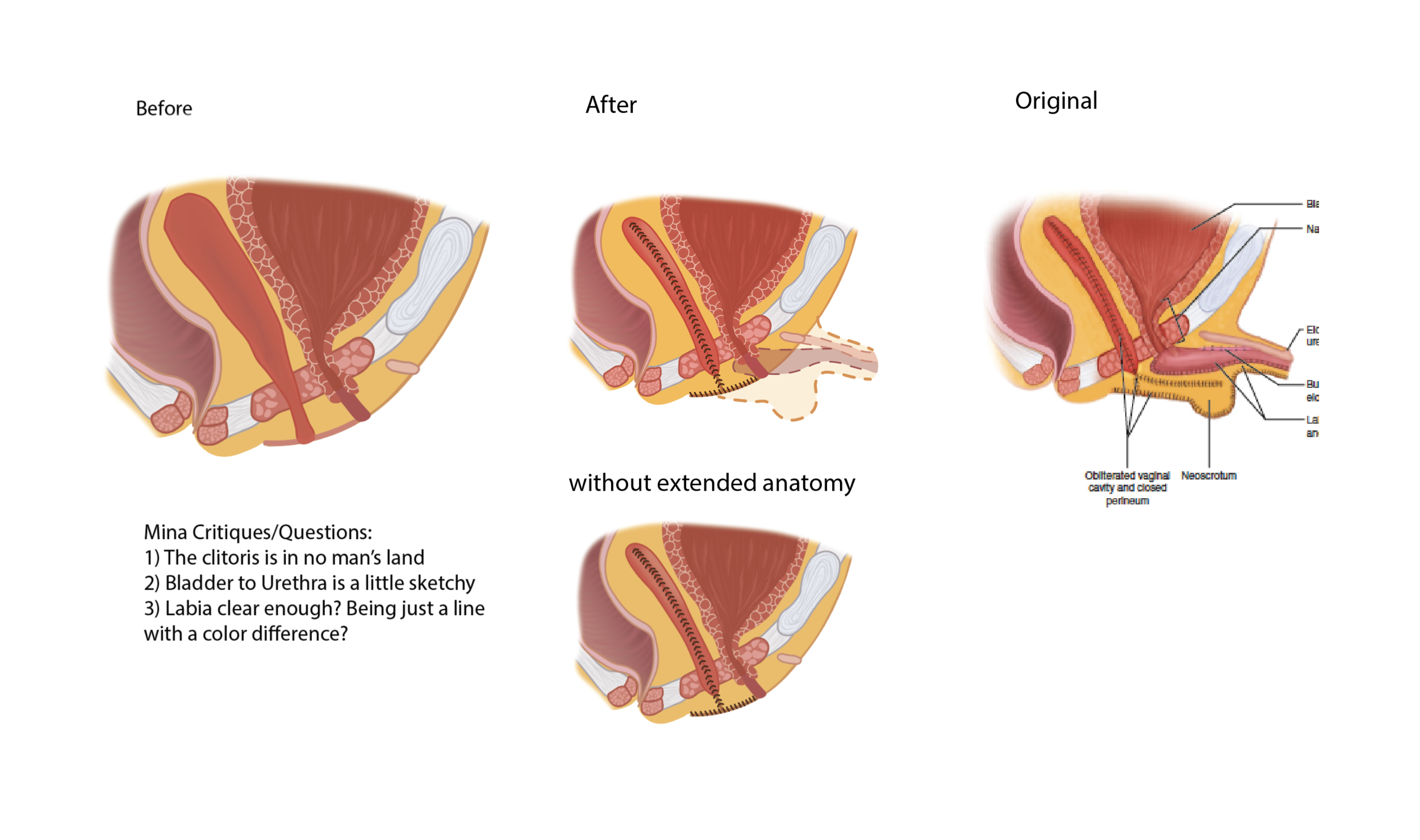
Description of image to left.
Outcomes/ Pro, Cons, Risks
Pros
A vaginectomy will lead to:
A ~60% lower risk of urethral stricture (narrowing of the pee tube) and fistula (connection between urinary tract and the outside world or other organs) if you have a penis created with urethral lengthening{Al-Tamimi, 2018 #12293}
A smooth perineum from anus to scrotum
Fewer gynecologic organs
Lower risk of cancer or other problems with the vagina
Cons
A vaginectomy is:
Irreversible
Must have a hysterectomy / ovary removal prior to or with vaginectomy
No longer able to become pregnant
Unable to have penetrative vaginal intercourse
Risks
A vaginectomy can lead to:
Injury to the rectum/bowel/intestines (requiring bowel diversion/stoma) (~1-2%)
Injury to the urinary tract (?%)
Need for repeat procedures (?%)
Anesthetic risks
Outcomes/ Pros, Cons, Risks
Pros
A vaginectomy will lead to:
A ~60% lower risk of urethral stricture (narrowing of the pee tube) and fistula (connection between urinary tract and the outside world or other organs) if you have a penis created with urethral lengthening{Al-Tamimi, 2018 #12293}
A smooth perineum from anus to scrotum
Fewer gynecologic organs
Lower risk of cancer or other problems with the vagina
Cons
A vaginectomy is:
Irreversible
Must have a hysterectomy / ovary removal prior to or with vaginectomy
No longer able to become pregnant
Unable to have penetrative vaginal intercourse
Risks
A vaginectomy can lead to:
Injury to the rectum/bowel/intestines (requiring bowel diversion/stoma) (~1-2%)
Injury to the urinary tract (?%)
Need for repeat procedures (?%)
Anesthetic risks